
Capturing Moments
on the Street
Unplanned moments, unprepared people, unpredictable light — that is street photography.
Questions you might have
Q. What should I do if I get a complaint while shooting street?
→ In principle, shooting in Korean public spaces is legal. If you receive a complaint, the wisest response is to say 'I'm sorry, I'll delete it' and delete the shot in front of the person. Asserting your legal rights is less useful than de-escalating smoothly — that's better for everyone.
Q. DSLR vs. mirrorless vs. compact — which is best for street?
→ The smaller the camera, the less the subject's guard goes up. A large DSLR looks like 'a professional photographer' and people become self-conscious. That's why compact cameras and small mirrorless bodies have an advantage on the street. Film cameras (especially rangefinders) actually appear as a 'retro hobby' and cause very little wariness.
Decisive Moment
The single instant when the subject's movement, light, and composition align perfectly. Henri Cartier-Bresson's concept.
Layered Composition
A technique of placing interesting elements in the foreground, midground, and background to create story and depth in the photo.
Zone Focusing
Pre-set the focus and just press the shutter. Captures decisive moments faster than AF.
How to Wait for the Decisive Moment
Good street photos don't come from chasing. The key is finding a great background, standing there, and waiting.
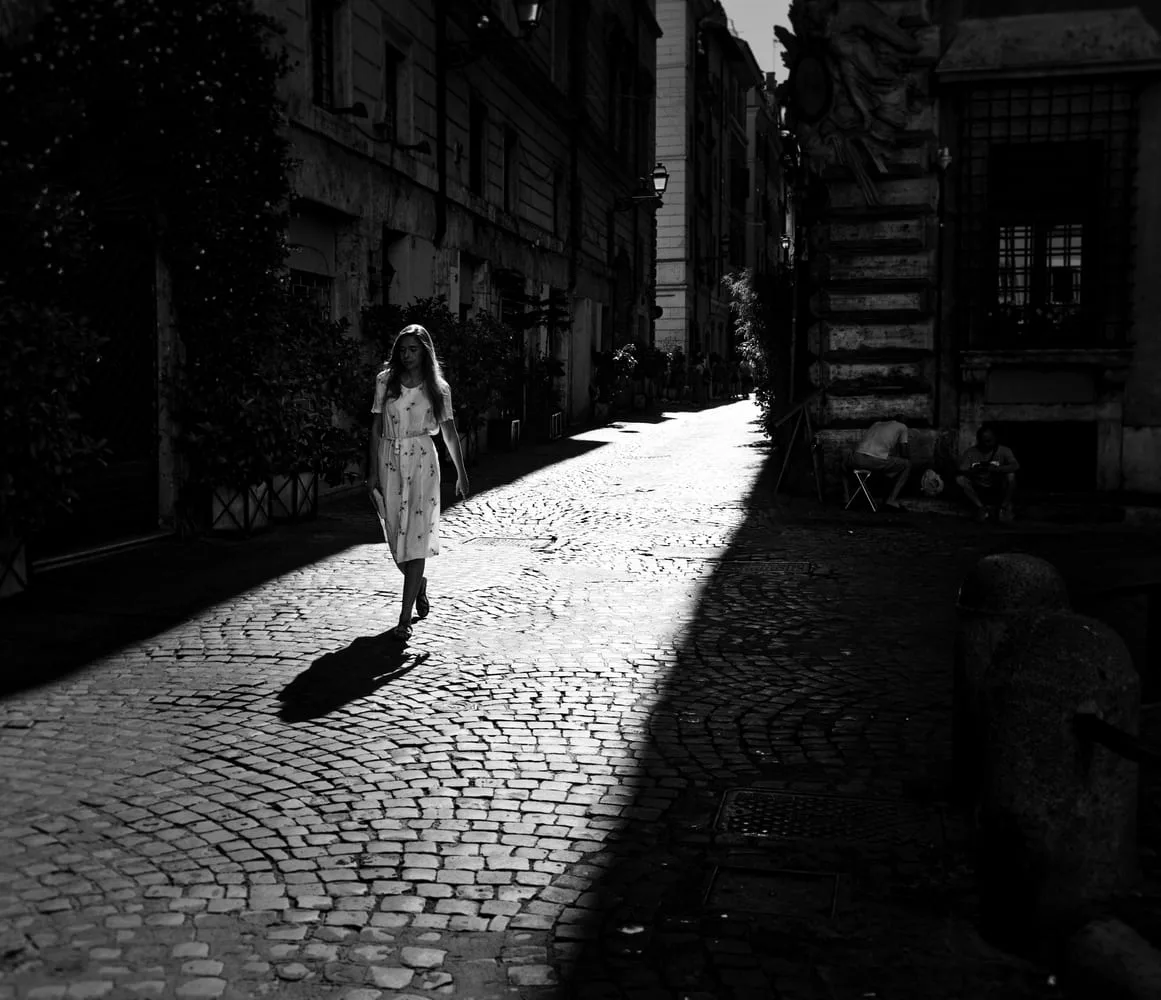
Find the Background First
An alley where light falls beautifully, a wall with geometric patterns — find the background first, then stand there and wait for a person to enter the frame.
Lock the Exposure First
Set the exposure to match the background brightness in M mode. So the camera doesn't lose the moment recalculating exposure when a person enters the frame.
Use Burst Mode
The decisive moment is a 0.1-second difference. Shoot 3–5 frames in burst and pick the best one.
Shoot More, Delete More
Even Henri Cartier-Bresson shot hundreds to get one keeper. Shooting 200 frames in a day and keeping 3 is a success.
Zone Focusing — Faster Than AF
Waiting for AF on the street means missing the moment. Zone focusing is a film-era technique where you pre-set the focus distance and just press the shutter.
How to Set Up Zone Focusing
Switch lens to MF (manual focus)
Set focus to 1–2m ahead (for 35mm wide angle)
Stop down aperture to f/8 or more for deep depth of field
When the subject enters that range, press the shutter immediately
렌즈
28~35mm
조리개
f/8~f/11
초점거리
1.5~2m
expand_moreAdvanced — Using the Lens DOF Scale for Greater Precision
Some manual-focus and modern lenses have a depth-of-field (DOF) scale printed on the lens barrel. For example, a 35mm lens at f/8 focused at 1.5m puts roughly 1m–3m within the depth of field.
Anything inside that range will be sharp even without AF. This is why manual-focus lenses with distance markings (Voigtlander, Zeiss, etc.) are popular for street photography.
Layered Composition — Photos That Tell a Story
Place interesting elements in the foreground, midground, and background to make the photo three-dimensional and alive.
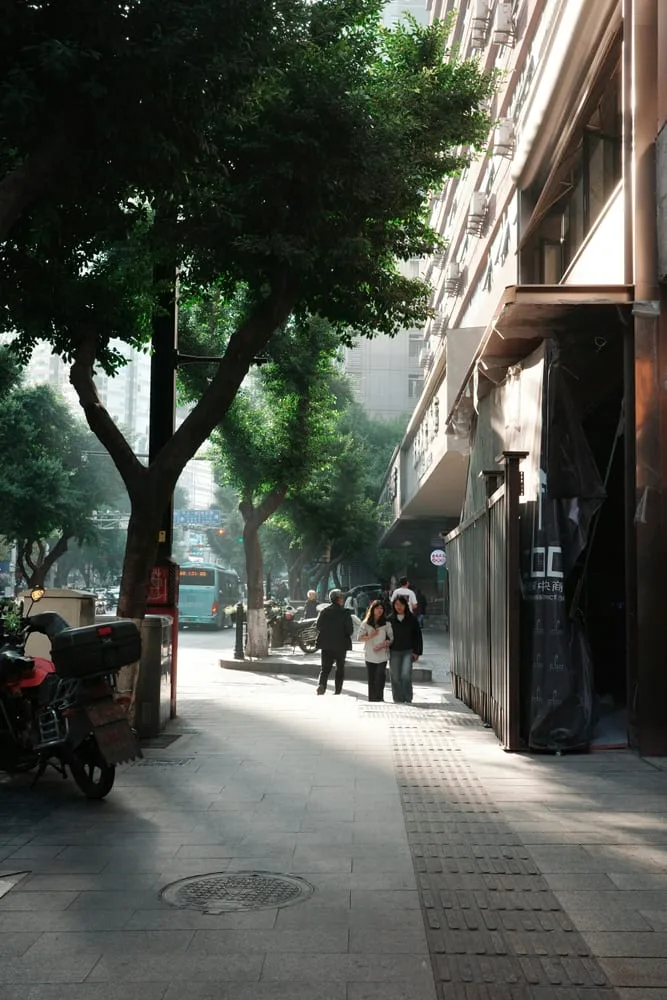
Foreground
- • Hand or foot fragment
- • Flowers or plants
- • Glass reflection
- • Floor shadow
Midground (Main Subject)
- • Person walking
- • Person in front of a poster
- • Two people in conversation
- • Street vendor in front of a shop
Background
- • Buildings and signage
- • Street fading into the distance
- • Sky and clouds
- • Light at the end of a tunnel
Use Light and Shadow as Design Elements
Find spots where strong sunlight strikes a narrow alley. Draw a line between the lit and shadowed zones in your frame — the moment someone crosses that line becomes a dramatic shot.
Photographing Strangers — Breaking the Psychological Barrier
The biggest wall in street photography isn't technique — it's the psychological distance.
Start with Backs and Silhouettes
Start with backs or silhouettes — faces not visible. Lower legal and ethical burden, and often produces even more emotional photos.
Practice in a Crowd
In crowded places like markets, festivals, or busy streets, cameras are less conspicuous. Practice focusing on one person within a crowd.
Wide Angle, Get Close
Getting physically close with a wide angle creates more powerful photos than zooming from a distance. It requires courage, but the results match.
When Eye Contact Is Made
If eyes meet, naturally smile and nod. Most people simply move on.
Korean Legal Note: Shooting unspecified individuals in public spaces is generally permitted in Korea. However, using specific individuals for commercial purposes or shooting with intent to invade privacy may cause legal issues. Use caution with photos showing clearly identifiable faces when posting to social media or exhibiting.
Recommended Street Photography Gear
In street photography, your eye matters more than your gear. But small, light, and fast cameras have the advantage.
※ Prices are based on 2025 and may vary with exchange rates and discounts.
Compact Mirrorless
Sony ZV-E10, Fujifilm X-S20, Canon M50, etc. The smaller, the lower the subject's guard.
Why: The smaller the camera, the less you look like 'a professional photographer,' making it easier to capture natural, unguarded moments.
35mm Prime Lens
The standard street focal length. Small, light, and fast. f/1.8–f/2 handles dark interiors and night.
Why: Similar to the human natural field of view, photos feel immediate and present. Best pairing with zone focusing.
Electronic Shutter (Silent Mode)
Electronic or silent mode creates no shutter sound, so subjects don't notice.
Why: Shutter sound causes reactions. Silent shooting captures more natural moments.
Film Camera (Rangefinder)
Nikon F3, Canon AE-1, Olympus OM-1, etc. Appears as a 'retro hobby' — very low subject wariness.
Why: The unpredictability of film and the anticipation of seeing results after development aligns with the street spirit. Black-and-white film recommended.
30-Minute Neighborhood Walk — 10-Shot Street Challenge
- →Walk your neighborhood for 30 minutes with just a camera (or smartphone)
- →When you find a spot where light falls beautifully, stop and wait 10 seconds
- →5 photos without faces — backs, shadows, reflections
- →2 shots with a person in the frame (using burst mode)
- →Upload your favorite shot to AI for composition feedback
More Content to Explore
마지막 업데이트: 2026년 4월